Uncategorized
Final “unsolicited Dad-advice” to the Class of 2026 (Part 1): “Good Goodbyes”
*Class of 2026, it’s not until I had you as freshmen that I started my silly tradition of giving “unsolicited dad advice.” It is, perhaps, a tradition that will end with you as well. As we enter the closing days of our time together, I can’t help but share a few more words before it’s all said and done. I may write a few more of these before May 12th. I hope you find them meaningful.
Good Goodbyes
Only a handful of days remain in this season of your life called "high school." And as this season of your life ends, I know many of you are experiencing a lot of strong feelings.
Graduation is often one of the first major goodbyes we experience in life. You are about to say goodbye to your childhood, your home, your friends, and your family–the place and people who have shaped you. In that sense, graduation is a big deal.
These goodbyes–good goodbyes–matter.
As a teacher who watches graduates walk out the door every May, I’ve learned a lot about goodbyes, and I want to share a few thoughts.
Say the words that need to be said.
We all carry the pain of unspoken words.
Sit for a moment with this question: Which words, and from whom, would most bring you healing or peace? Chances are, those words would come from someone you really care about. Likely, those words would be some form or combination of “I love/appreciate you,” or “I’m sorry,” or “I’m proud of you,” or “You mean a lot to me.”
We may yearn for a parent to say, "I'm so proud of you" or "I'm sorry for the ways I've wounded you." We may yearn for a former friend to tearfully whisper, "I'm sorry for the pain I have caused." We may yearn for someone to throw their arms around us and exclaim, "My life has been so much better because you were in it." Or we may yearn for someone to gently say, "I forgive you."
And if we could only hear those words, so much pain and doubt and grief and regret would begin to disappear.
Consider, too, the words you wish you had spoken to a departed loved one, a long-lost friend, or a long-time crush. We carry the burden of the words we desperately wish to hear, but we also carry the burden of the words we desperately wish we had spoken. Sometimes, we never get a second chance to say those words.
So many words in this world remain unspoken because we’re hurting or because we’re terrified of being vulnerable or awkward or rejected. We’re scared of how our words might be received or perceived.
Please don’t allow your fear masquerade as indifference. Please don’t let fear be the reason you leave words unspoken.
Sadly, not everyone will give you the goodbye you are hoping for. You can't control the goodbyes you receive, but you can control the goodbyes you give. Your goodbyes can be good ones, and you can speak the words that need to be spoken–the words that heal.
I would challenge you to speak the words that need to be said. Tell people what they mean to you, how they inspire you, how they’ve impacted you, or how much they’ll be missed. It doesn’t need to be anything profound or even personal. Tell someone you’ve enjoyed being in classes with them, or how much you like their laugh, or the one thing you’ll always remember about them. The older I get, the more I realize how much we all want the same two things. First, we want to be seen and heard. Second, we want someone to tell us that we’re okay–that we are good enough, that we are loved, that we are appreciated, that we are admired. I passionately believe that sharing words that make people feel seen, heard, or cared for--but they must be both kind and true--are the greatest gifts we can give. Please don't let those words go unsaid.
Likewise, there is so much healing and so much power in the words “I’m sorry.” Saying sorry doesn’t excuse the behavior or the pain, but two amazing things tend to happen when we offer an apology. First, the person receiving the apology feels seen and heard because you’ve shown them that you see their pain and acknowledge your part in it. You show them that their pain matters and that causing them pain has pained you, too. Second, you’ll find that a weight has been lifted from your shoulders. Do it for them, but also do it for you–for your own sense of integrity and peace. Leave ERHS knowing that you’ve attempted to heal the pain you may have caused, even if that pain was unintentional. And if you’re the recipient of an apology, please receive it with grace. Someone has seen you and acknowledged the sorrow they have caused you. They are trying to make amends. And that’s a very kind and brave thing to do.
Please make amends while you have the chance. You won't regret it.
Class of 2026, I have always implored you to live a life with no regrets. Speak the words that need to be spoken and leave with your head held high. When you walk out the doors of ERHS, leave behind the gift of a lot of really good goodbyes. Don't leave behind regrets.
Say your goodbyes to this place
How do you say goodbye to a place that will always hold your childhood? How do you say goodbye to a place that holds a piece of your heart? How do you say goodbye to the fireweed in September, or to the aurora, silently dancing above the moonlit mountains in December, or the breathtaking light on the mountains in February? How do you say goodbye to the endless light of summer, or the smell of campfire smoke on your clothes after a camping trip with friends, or the softness of the tundra under your feet?
You’ve grown up on the edge of the Alaskan wilderness. For many of you, these mountains, rivers, and forests have become some of your most faithful friends.
Many of your families are moving away from Alaska this year. And even if your family has put down roots here, you might, at most, come home for a few holidays during the school year. Maybe you'll have a few more Alaskan summers before internships, grad school, military obligations, or careers take you far, far away.
How do you say goodbye to a place? What does a good goodbye look like when you’re saying farewell to Alaska and a piece of your childhood? That may be one of the hardest goodbyes of all. Make it a good one. Drink up every moment of beauty between now and then. Spend time in the mountains or beside the river, making sure you say goodbye to those faithful friends, too.
One last adventure.
Here are some ideas as you contemplate these upcoming goodbyes.
1. The Adventure: Put a date on the calendar now for “one last adventure” with your friends before you all depart. Despite all the good intentions and heartfelt promises, with so many of your families moving out of state, there’s a good chance there will come a moment this summer when you and your friends will be all together, all at once, for the very last time in your lives. Acknowledge that. Make this last adventure special. Put aside all the weird dynamics, petty bullshit, or past drama. Plan one last adventure, knowing it might be the very last time you’re all together. Savor every moment. Forget everything else. Make it count.
2. The Campfire: If possible, make sure your last adventure includes a campfire. There’s something hallowed about friends gathered around a fire together–somehow, all the words and silence and laughter feel more significant as you gather in a circle watching the dancing flames. Better yet, have everyone write a reflection on the significance of these past years and the love and memories you have shared. Have everyone read those reflections aloud as you sit around the fire. Say the words that need to be spoken. Make it an unforgettable night of laughter and tears and memories.
The Spot: Finally, if you or your friends are moving away, make a pact. For instance, if you all share a special spot in nature, make a pact that, for the rest of your lives, if someone visits that spot, they send a picture of themselves in that spot to the rest of the group, even if it’s been a decade since you’ve last spoken. Places hold power. Even if you’re never all together again, every time you return to that place, you share in that connection with all your friends, no matter where they live, what their lives look like, or how long it’s been since the earth has felt their footsteps. Maybe you return to that spot in the darkest moments of your life and remember past joys. Maybe you return 25 years later with your own children in tow, sharing that special place with them too. Maybe you will never return at all. But that space will always hold memories and echoes of your friendship. It will always be waiting for your return...
Summer 2025 Idea: Grandview Whistlestop!
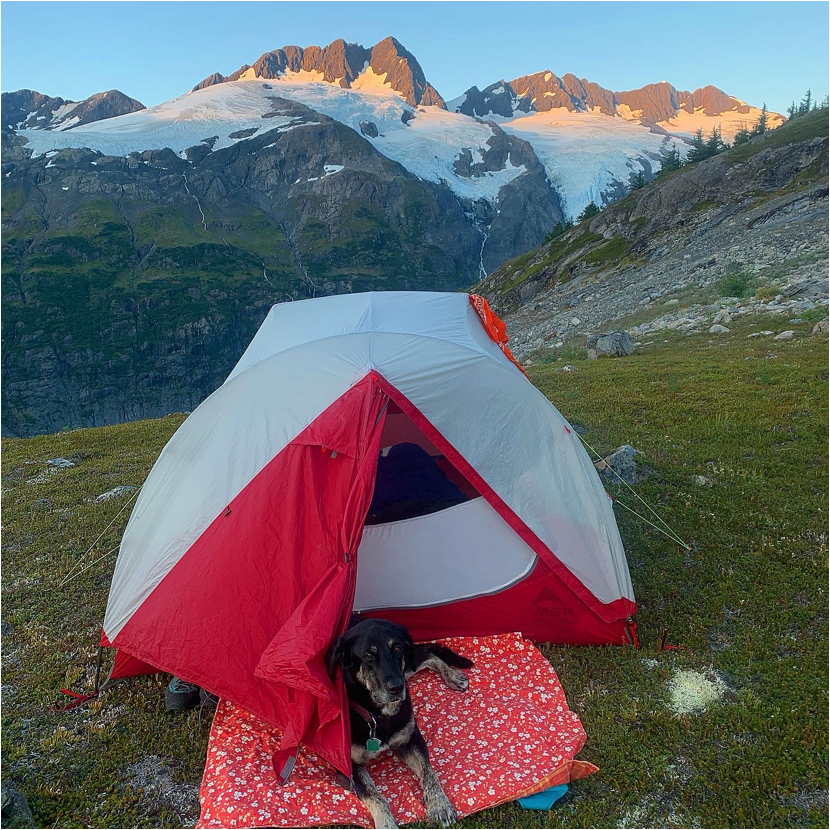
One of my big adventure priorities is to camp/hike/explore at the Grandview Whistlestop. Knowing how much snow they get up there, I don't think this trip would be feasible or enjoyable until mid-July. You buy a train ticket ($110rt) to depart from the Portage train station. Once you get on the train, in winds through a river valley, up a mountain, and through some tunnels, and then the train stops on the tracks and drops you off in Grandview, an old, abandoned trading route in the middle of the wilderness between Portage and Seward. You hop off the train, find a spot to set up your tent, and start exploring!
The Forest Service has just recently put in some trails (and they plan to install mountain huts to create a longer hut-hop trail), but it sounds like you can explore glaciers and alpine meadows and peaks. Camp for as many days as you'd like, then be at the train platform in time to catch the northbound train and come home!
(Attached pic not mine...yet.)
Alaska Road Trip Ideas
Multi-day:
Epic Trip #1:
- Get up early and drive up the Parks Highway.
- Take a right at Cantwell onto the Denali Highway. Bring a spare tire or two. You’ll have to drive in about 30 miles to get past Native land and onto public land to camp. Take your time driving this road, which is mostly gravel, and bring a spare tire and know how to change it. It’s beautiful! Camp at Clearwater Creek (about 60 miles in).
- The next day, drive to the Tangle Lakes area and camp there for the night.
- The next day, drive to Delta Junction. The drive there is gorgeous. Get ice cream at the shop at the “Y” of the Richardson and Alaska Highways. Get a bison burger while you’re in town too! Take a right onto the Alaska Highway toward Tok. Go to Tok and head south on the Tok Cutoff Highway. Camp somewhere along the Tok Cutoff.
- The next day, drive home (or go to Valdez!). On your way home on the Glenn Highway, like Lion’s Head near Matanuska Glacier.
Epic Trip #2:
- Buy tickets for you, your friends, and your vehicle for the ferry between Whittier and Valdez.
- Head south and take the tunnel to Whittier.
- (Add an extra day by spending the night in Whittier and hiking the Blackstone Vista trail!)
- In Valdez, camp at the military campground.
- On day 2, explore the town of Valdez and the waterfalls in the canyon north of town.
- On day 3, drive north on the Richardson Highway. Stop in Thompson Pass for a day hike and check out the glaciers (but be careful!)
- Keep driving until you see the turnoff for Chitina and McCarthy. Drive to McCarthy.
- Camp in the private gravel lot at the end of the road near the footbridge.
- Spend a day or two exploring McCarthy and Kennecott mine. You absolutely must hike out to the Root Glacier!
- The next day, drive home (or camp near Caribou Creek). On your way home on the Glenn Highway, hike Lion’s Head near Matanuska Glacier.
Most Epicest of Epic Roadtrips:
Combine Epic Trip 2 with Epic Trip 1. Start in Whittier; do Valdez and McCarthy; go north to Delta Junction after McCarthy; after Delta Junction, turn around the way you came and go back south to Paxson to drive the Denali Highway, then take the Parks Highway south back to Anchorage. Give yourself at least a week!
Graduation Speech 2024

Here is the graduation commencement speech I gave yesterday...
First, class of 2024, congratulations. You made it.
Secondly, I’m flattered that you allowed me to speak today, this last occasion when you are a captive audience to anyone in the Anchorage School District. And it was a brave choice to choose an English teacher to give this speech, especially one so notorious for his tangents. You willingly signed yourself up for a speech likely to contain big words and obscure poetic references. That’s brave.
You know what else is brave? Those of you wearing high heels today. Have you seen the gauntlet that is this graduation stage? That is brave.
But here’s the thing: You are a brave class. Because you had to be.
In seventh grade, many of you watched as your middle school started to shake and crumble around you. And you were brave. Because you had to be.
A few weeks later, as terrified 12-year-olds without your own school building, many of you entered the halls of Chugiak High School to continue your education, gripping your chairs at every aftershock and sharing a building with bearded 18-year-old seniors driving big, loud pickup trucks. And you were brave. Because you had to be.
A year and a half later, you were told you couldn’t come back to school. You spent a portion of the most formative years of your life hunkered down, watching as disease and civic strife spread around you. And you were brave. Because you had to be.
Then came your first day of high school. At 7:30am on August 20th, 2020, you opened your Chromebooks. You logged into your Zoom link, found yourself in the waiting room, muted your mics, turned on your video, and took a nervous breath as your 1st-hour teacher admitted you to your first day at Eagle River High School.
A brief tangent: You guys were so cute! After all, how do you look and act like a brand-new, sophisticated high school student when high school is online?
Some of you logged in to your first day of high school looking like an aspiring Twitch streamer. You had fancy headphones, multiple monitors, mood lighting, and impressive webcams. Some of you showed up trying to look like sophisticated high schoolers with your perfect “fit” –your hair and makeup were perfect, your clothes were carefully chosen, your room was clean – only to find that your “perfect fit” only occupied a tiny square on a screen where no one could really appreciate it. Some of you logged in from an executive-looking desk in a home office looking like important 14-year-old real estate brokers. And some of you entered your first day of high school by peering bleary-eyed from beneath a cavern of blankets like some sort of scraggly, pubescent troll. You were all, kinda adorable.
…
Brief tangent on a tangent: Ya’ll own a surprising number of cats. And a surprising number of those cats like to walk across your keyboard and into the view of your webcam in the middle of class. It was actually super cool to meet your pets.
And while I’m trying to be amusing, I’m not trying to be flippant. You all walked hard miles those years. Some of you lost loved ones. Some of you struggled with the isolation of Covid, the dark depths of mental health struggles, difficult family dynamics, and a world that seemed off its axis. But you were brave. Because you had to be.
You continued to walk hard miles during your sophomore year as you desperately tried to catch up on your learning by intently listening to the muffled, masked voices of your teachers… You had to figure out how to be around people again. And again you were brave. Because you had to be.
Class of 2024, you’ve walked a lot of hard miles. And please forgive the “dad pun,” but despite all the hard miles you’ve walked, when I look out at you right now, I still see a lot of good souls…
…
At this point, you might be like “Ok Johnson, I get it. We were brave because we had to be. What’s the point? What are you really trying to say?”
Brief tangent: If you’re asking those questions, then on behalf of the Eagle River High School English Department, I’ll call that a win (or a “dub,” as you young people say.) If, at the end of your high school career, you’ve learned nothing else from your English classes, I hope it’s how to ask the deeper questions. Because life is deep, and life is complicated. Please never lose the curiosity and passion to ask yourself, and the people and the world around you, the deep and hard questions in life. Likewise, I hope you never lose the desire to listen deeply and to read deeply to find the answers.
But back to my main point about bravery, which is twofold:
First, I hope at this point in your life, and after all those English classes, you realize that life is full of competing narratives. And almost none of those narratives hold a monopoly on truth. ..For example, imagine you are ten, and you’re in trouble with your parents because you and your little brother got bored, decided it would be a good idea to toss a cantaloupe around, and broke a light fixture in the kitchen. (Sorry mom) It’s amazing how quickly two very different narratives emerge from two people who have each experienced the exact same event, especially when the threat of being grounded hangs in the air.
My point is this: Consider your own narrative. It’s easy to fall into the easy narrative that you are simply the powerless protagonist at the mercy of forces far, far bigger than you.
That narrative might make for a good story, but I’m not sure it makes for a good life.
I also think you’ll find that adult life is littered with the wreckage of people who have simply surrendered to that narrative, to the story that they are the helpless victims of circumstances beyond their control.
I would challenge you to consider a different narrative, a deeper narrative. I would challenge you to adopt the narrative that you are, in fact, brave, that you have walked a lot of hard miles while managing to maintain a good soul, and that you are capable of walking a few more.
My second and final point about this “bravery stuff” is this:
You were brave because you had to be.
But now, in just a few minutes, you get to be brave not because you have to be, but because you get to choose to be.
You get to choose to be brave in the face of injustice. You get to choose to be brave in the face of an uncertain future and an uncertain world. You get to choose to be brave in the way that you live and in the way that you love.
And class of 2024, here’s the really cool thing. You have so much practice at being brave... Because you had to be. I think that the class of 2024 has had more practice being brave than any other graduating class in recent memory. And I also think that everyone in this audience can agree that the world could use more people who live bravely and who love bravely.
And so, class of 2024, choose to be brave. Whether you become a plumber or a pilot, a soldier or a ski bum, a dental hygienist or a doordash driver, think bravely. Speak bravely. Live bravely. And please, please, please…love bravely.
Congratulations class of 2024, and as each of you bravely step off of this stage (especially those of you in heels), I hope you step into a remarkable future.
“Classics” I recommend
British
Charles Dickens
David Copperfield – a semiautobiographical novel set in Victorian England. It’s really good. It starts with David as a young boy and follows him into adulthood. It has twists, turns, tragedy, and romance. It’s funny, has hilarious and memorable characters, and some really touching moments. It was wildly popular when it was initially published. (Like a TV show, individual chapters were published every month or so. People went crazy for the newest “episode.”)
From Wikipedia: “The novel has a primary theme of growth and change, but Dickens also satirizes many aspects of Victorian life. These include the plight of prostitutes, the status of women in marriage, class structure, the criminal justice system, the quality of schools, and the employment of children in factories.”
Dickens is a slow, descriptive writer, and the book is long. But once you get invested, it’s hard to put down and is an excellent text to improve your reading skills.
DH Lawrence
Sons and Lovers – DH Lawrence is the guy who wrote “A Rockinghorse Winner,” the short story I likely gave you in class. In this book, Lawrence “traces emotional conflicts through the protagonist, Paul Morel, and his suffocating relationships with a demanding mother and two very different lovers, which exert complex influences on the development of his manhood” (Wikipedia). I love DH Lawrence's writing style and the way he gets deep into the minds of his characters.
Lady Chatterly’s Lover – I haven’t read this one yet, but I know it is one of his most famous novels, and at the time, was the subject of censorship due to “obscenity” (in 1929). According to Wikipedia, “The story concerns a young married woman, the former Constance Reid (Lady Chatterley), whose upper-class Baronet husband, Sir Clifford Chatterley, described as a handsome, well-built man, is paralyzed from the waist down because of a Great War injury. Constance has an affair with the gamekeeper, Oliver Mellors. The class difference between the couple highlights a major motif of the novel. The central theme is Constance's realization that she cannot live with the mind alone. That realization stems from a heightened sexual experience that Constance has felt only with Mellors, suggesting that love requires the elements of both body and mind.”
Thomas Hardy
Hardy is really tough, but he’s one of my favorite authors. He uses lots of thick descriptions and can be a struggle to get through. However, his descriptive, dense writing is totally worth it. The plots of his novels are excellent. I read my first Hardy novel in AP Lit and it’s stuck with me ever since.
Tess of the d'Urbervilles - An absolutely heartbreaking novel about a poor young woman. She is raped (maybe. It’s very ambiguous), gives birth to a child, starts over, almost finds happiness, and then things get absolutely bonkers at the end. My favorite Hardy novel.
Jude the Obscure- A bright young man is seduced by a woman who pretends to be pregnant with his child. Things get wild from there, and the ending of the book is also absolutely bonkers.
A Pair of Blue Eyes – A girl must decide between two men: one older and successful and one who is ambitious but “below” her station.
Far From the Madding Crowd - One of his only happy novels. A young woman inherits a farm and instead of marrying, decides to run the estate herself. She must make the choice between three different men.
American:
John Steinbeck
John Steinbeck writes some great fiction set in early 20th-century America, often during the Great Depression. Grapes of Wrath, Of Mice and Men, and Cannery Row are some of his most famous novels. You may read Of Mice and Men junior year, but that’s a good introduction to Steinbeck. Grapes of Wrath is excellent, but long.
Earnest Hemingway
Hemingway was a man’s man in every respect of the world. Seriously. Go read his biography on Wikipedia. It’s insane. His writing is sparse, direct, and simple, but there is always a ton of stuff simmering under the surface. He’s best known for stories and books like “Old Man and the Sea,” For Whom the Bell Tolls, A Farewell to Arms, and The Sun Also Rises. I’ve read a number of his short stories, but have yet to finish one of his novels.
Scott Fitzgerald
Scott Fitzgerald is known as an early 20th-Century author who was obsessed with wealth, ego, and the “Golden girl” – the girl every other girl wants to be and the girl every guy wants to be with. Start with his short story “The Offshore Pirate.” While he is best known for his novel The Great Gatsby, I like his first novel, This Side of Paradise way more. It’s a semi-autobiographical account of a young, upper-middle-class young man who learns more about himself, love, status, and meaning in the ballrooms and campuses of the rich in America. I always feel like a brilliant, sophisticated, tortured soul after I read his fiction.
E.B. White
E.B. White, largely known for “Charlotte’s Web” and “Stuart Little,” is one of the best American essayists of the 20th century. He published a lot of stuff; find something that interests you. I particularly love his autobiographical story “The Years of Wonder” about being a broke young man, convinced he was an unappreciated genius, who boards a cruise ship bound for Alaska. If you read it carefully, it’s laugh-out-loud funny.
Judith Wharton
Ethan Frome is a novella about a man in and New England town who is unhappily married to a sick wife. His wife’s younger cousin, full of vibrance of life and passion, comes to stay with them and care for her. He falls for the cousin, and when she is about to be sent away, Ethan considers running away with her. The story ends tragically. This one hits hard.
Other:
Chekhov
Largely considered the world’s best short story writer and writer in general. He was a realist writer from Russia. His stories give “a reflection of ourselves in our unadorned ordinariness as well as our unfathomable strangeness” (Lasdun). His stories aren’t dramatic, but they’re full of nuance and moodiness. I would Google famous Chekhov stories and see if you like them!
Hermann Hesse
Steppenwolf - This is the first Hermann Hess novel I’ve read, but I’ve liked most of them. Hesse writes a lot about purpose, spirituality, and self-development; according to Wikipedia, many of his novels explore “an individual's search for authenticity, self-knowledge, and spirituality.” In this novel, a middle-aged, middle-class man lives a miserable existence. He is given a pamphlet for a “Magic Theater” and a pamphlet called “The Treatise of the Steppenwolf” which is about “a man who believes himself to be of two natures: one high, the spiritual nature of man; the other is low and animalistic, a ‘wolf of the steppes.’ This man is entangled in an irresolvable struggle, never content with either nature because he cannot see beyond this self-made concept. The pamphlet gives an explanation of the multifaceted and indefinable nature of every man's soul, but Harry is either unable or unwilling to recognize this. It also discusses his suicidal intentions, describing him as one of the ‘suicides’: people who, deep down, knew they would take their own life one day. But to counter that, it hails his potential to be great, to be one of the ‘Immortals’” (Wikipedia).
Other Hesse novels I like:
Siddhartha - You may read this one sophomore year. A young man in India searches for Enlightenment at the same time the Buddha has reached enlightenment, but Siddhartha’s path is much different. This on hits hard.
Narcissus and Goldmund - Two young men search for meaning and take two totally different paths. That’s kind of a shitty summary that doesn't do it justice. It’s really, really good.
Beneath the Wheel - A young, intellectually gifted man pursues knowledge but not personal or social development. Also a very good novel and, perhaps, a cautionary tale for young people who place ALL their value on academics.
Poetry:
Poetry is tough to recommend. Everyone likes different types of poetry. I’m a big fan of the Romantic poets (Wordsworth, Coleridge, Keats, Byron, Shelley), but they’re tough and are probably best read with an explanation from a teacher/video/website to fully understand. If you’re looking for more “Classic” poetry, consider looking at a poetry anthology like the ones published by Norton. You can even just look at the table of contents in such anthologies and often find the poems online for free.
If you’re looking for more modern, accessible poetry, there’s actually a lot of good stuff out there. In fact, I’m increasingly seeing young people sharing their original poetry on Instagram. If you’re looking for short, simple, hard-hitting, and occasionally spicy poems written from a female perspective, consider the book of poems Milk and Honey by Rupi Kaur.